



Learn how missing or inaccurate lead source data affects sales follow-up, campaign decisions, CRM quality, and marketing confidence.
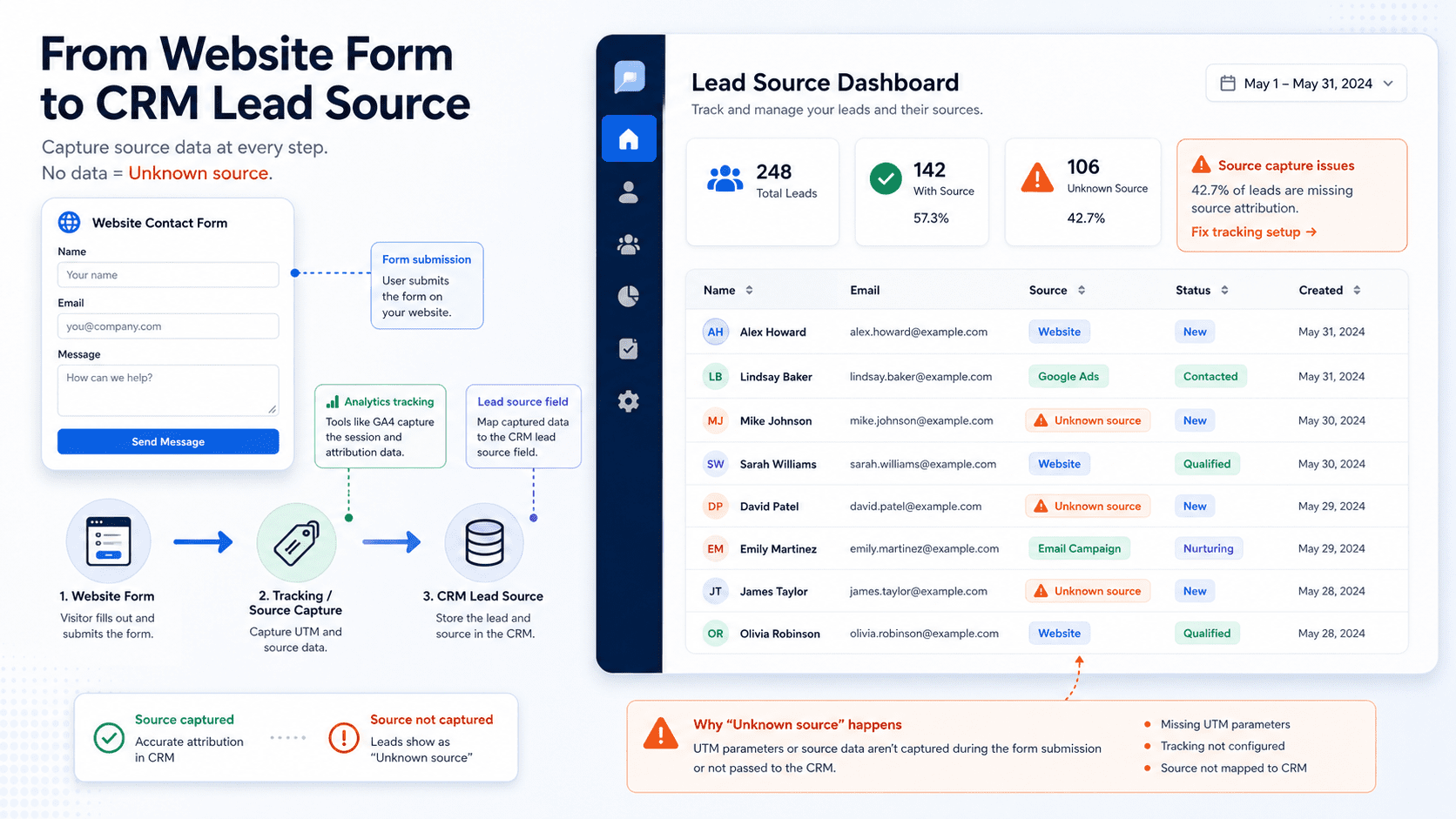
Many businesses know how many enquiries they received last month.
Fewer can confidently say where those enquiries came from.
That gap matters. If your CRM is full of leads marked “Website,” “Unknown,” or “Manual entry,” it becomes difficult to know which campaigns, pages, referrers, or channels are actually producing opportunities.
Lead source data does not need to be perfect to be useful. But it does need to be consistent enough for the business to make better decisions.
When source data is missing or wrong, marketing teams struggle to judge performance. Sales teams lose context. Business owners hesitate over where to invest. Website improvements become harder to prioritise because the connection between traffic, enquiries, and revenue is unclear.
This is not just a reporting issue. It is a lead-flow issue.
Source data is part of the handoff
A website enquiry is not only a name, email, and message.
A useful lead record should also answer:
Where did this person come from?
Which page did they convert on?
Which campaign influenced the enquiry?
What form did they submit?
Which service were they interested in?
What should the sales team know before replying?
If the website captures the enquiry but loses this context, the sales process starts with less information than it should.
For example, a prospect who submits a form after clicking a Google Ads campaign for “WordPress support” should not arrive in the CRM as a generic website lead. The sales team should see that the person came through a WordPress support campaign, submitted a specific landing page form, and may be interested in ongoing care.
That context helps the first response feel relevant.
Traffic source and lead source are not always the same thing
One common mistake is treating website analytics and CRM source data as interchangeable.
Analytics tools can show where website visitors came from. A CRM should show where actual leads came from. These two systems need to agree closely enough to support decision-making, but they are not the same.
Analytics may record a session from organic search. The CRM may only receive “Contact form.” Analytics may show a paid campaign generated conversions. The CRM may not store campaign names at all. A sales report may show “Website” as the source, while marketing wants to know whether the enquiry came from LinkedIn, Google Ads, email, referral traffic, or direct search.
If the CRM does not receive enough source detail, reporting becomes shallow. The business may know that the website generated enquiries, but not which parts of the website or which campaigns performed.
Why lead source data goes missing
Missing source data usually comes from small configuration gaps.
A WordPress form may not include hidden fields for UTM parameters. A landing page may have been built quickly and connected to the CRM without campaign tracking. A form plugin may pass visible fields but not hidden metadata. A CRM integration may map name, email, and message, but ignore source fields.
Sometimes the data is captured but not stored in a useful place. For example, UTM values may appear in a form entry inside WordPress, but not in the CRM. Or the CRM may store the original source, but sales reports use a different field that no one maintains.
Other times, the source data is overwritten. A lead originally came from Google Ads, but after a later email click, the visible source changes. Or a manual CRM edit replaces a specific campaign source with a generic value.
There can also be consent and tracking complications. Cookie banners, browser privacy settings, or analytics configuration choices may affect what can be tracked. That does not mean source tracking should be abandoned. It means the business needs a realistic setup that captures what it can, consistently and transparently.
The business impact of poor source data
Poor source data affects several parts of the business.
Marketing decisions become less reliable
If campaign source data is missing, marketing performance becomes harder to judge.
A campaign may appear weak in the CRM because leads are arriving as “Website.” Another channel may be credited too often because source values are selected manually. Organic search may be underreported because landing page forms do not pass referral or page data.
This makes budget discussions harder. The team may pause campaigns that are producing qualified leads or continue funding activity that produces low-quality enquiries.
Sales follow-up loses context
A sales team should not need to investigate every enquiry from scratch.
If a lead submitted a form on a landing page about CRM integration support, that should be visible. If they downloaded a guide about WordPress maintenance and later requested a call, that context matters. If they came through a campaign for a specific service, the reply can be more relevant.
Without source and page context, every enquiry looks more generic than it is.
Reporting becomes harder to trust
Once teams stop trusting CRM reports, they often create side spreadsheets.
That may solve an immediate reporting problem, but it creates another operational layer. Now the business has analytics, CRM records, spreadsheets, and manual notes. Each may tell a different story.
The goal is not to create perfect attribution. The goal is to make the main reporting systems trustworthy enough to support decisions.
Website improvements become harder to prioritise
If you cannot see which pages and forms generate quality enquiries, it is harder to know where to improve.
A service page may attract fewer visitors but generate better leads. A landing page may convert often but produce poor-fit enquiries. A form may perform well for one campaign and poorly for another.
Without clean source and conversion data, optimisation becomes guesswork.
Practical lead source diagnostic checklist
Use this checklist to review your current source tracking.
Website and form setup
- Do important WordPress forms capture the page URL?
- Do forms capture UTM parameters where relevant?
- Are hidden fields configured correctly?
- Are campaign landing page forms using the same tracking logic as main website forms?
- Are form entries stored somewhere for backup review?
CRM handoff
- Does the CRM receive source, medium, campaign, landing page, and form name where available?
- Are these fields mapped to useful CRM properties?
- Are values consistent, or does the team use multiple labels for the same source?
- Are source fields overwritten by later activity?
- Can sales see the source context without searching elsewhere?
Analytics and tracking
- Are form submissions tracked as conversions?
- Are thank-you pages or events configured correctly?
- Are UTM parameters preserved through redirects?
- Are cookie consent settings understood?
- Do CRM lead counts broadly align with analytics conversion data?
Reporting
- Can you report enquiries by channel?
- Can you report enquiries by landing page?
- Can you distinguish paid, organic, referral, email, and direct enquiries?
- Can you see which campaigns generate qualified leads, not just form submissions?
- Are reports simple enough for decision-makers to use?
Process
- Who owns source tracking quality?
- Are new landing pages checked before launch?
- Are new forms tested for tracking and CRM mapping?
- Are source values reviewed monthly?
- Is there a documented naming convention?
What recurring lead-flow monitoring should include
Lead source tracking should be reviewed as part of ongoing lead-flow monitoring.
A monthly review can test key forms, inspect CRM records, compare analytics conversions, check UTM capture, and identify missing or inconsistent source values. It can also catch problems after new campaigns, landing pages, plugin changes, CRM field edits, or tracking updates.
This does not require overcomplicated attribution modelling. Many businesses simply need a reliable chain from visitor source to form submission to CRM record to sales follow-up.
When that chain works, teams make better decisions.
Know where your website leads are really coming from
Muser Agency helps businesses monitor forms, source tracking, CRM handoff, and conversion data so marketing and sales teams can work from cleaner lead information.