



ChatGPT Ads are changing how businesses may reach buyers. Learn how to prepare your offer, landing pages, tracking, and follow-up.
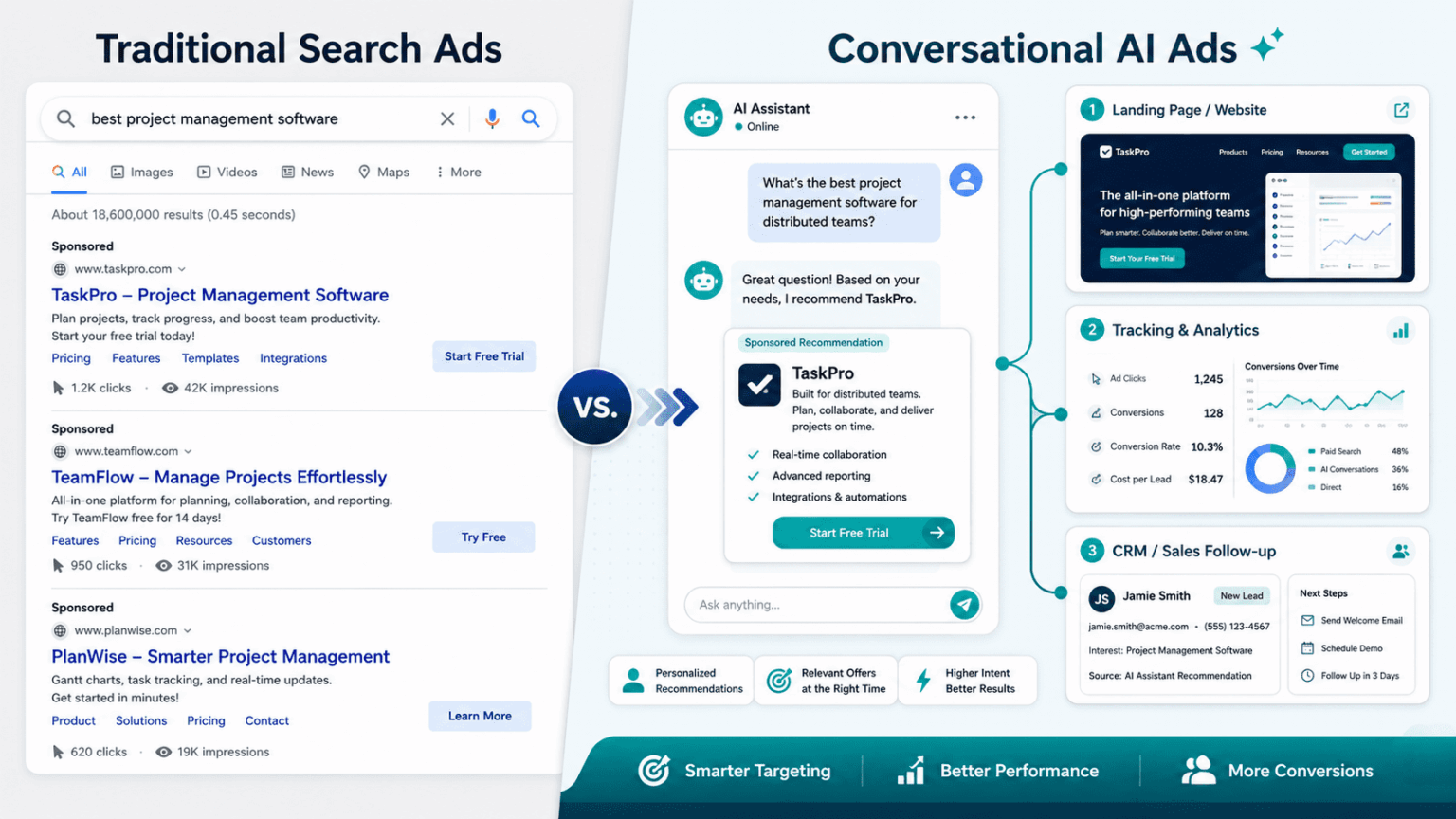
ChatGPT Ads are not just another ad placement to watch. They point to a larger shift in how people may discover, compare, and choose businesses.
The opportunity depends on clear offers, strong pages, tracking, and follow-up.
For years, digital advertising has been built around search keywords, social feeds, retargeting audiences, and landing pages. Those channels still matter. But conversational AI changes the starting point.
Instead of typing a short keyword into a search engine, a potential customer may explain what they need in detail. They may ask follow-up questions, compare options, describe their situation, and move closer to a decision inside the conversation.
That changes what businesses need to prepare.
The opportunity is not simply to “run ads in ChatGPT.” The opportunity is to be ready when a customer is actively asking for help with a problem your business can solve.
OpenAI says ChatGPT Ads are designed to appear below relevant conversations and are selected primarily around conversational context and intent rather than simple keyword matching. OpenAI also says ads are clearly labeled, answers remain independent from ads, and conversations are kept private from advertisers.
That means the strongest businesses will not be the ones with vague advertising messages. They will be the ones with clear offers, useful landing pages, clean tracking, and fast follow-up.
Why ChatGPT Ads matter
Traditional search advertising often starts with a keyword.
A person searches for something short and direct:
“homes for sale near me”
“property valuation”
“best running shoes”
“commercial cleaning company”
“accountant for small business”
“office furniture supplier”
“property management company”
The advertiser responds with an ad and sends the person to a landing page.
Conversational AI is different because the user may describe the situation in more detail.
A homeowner may ask:
“How do I find out what my property is worth before deciding whether to sell?”
A buyer may ask:
“What should I look for when choosing a home in this area?”
A shopper may ask:
“What sofa would work best in a small apartment with pets?”
A facilities manager may ask:
“What should I ask before choosing a commercial cleaning company for a multi-site office?”
A founder may ask:
“What kind of accountant do I need if my company is expanding into another country?”
These are not just keywords. They are buying situations.
That is the important shift.
ChatGPT Ads may place businesses closer to the moment when a customer is researching, comparing, or preparing to act.
Conversational ads require a different mindset
A ChatGPT ad cannot rely only on a broad brand message.
A person using conversational AI is often trying to make a decision. They may be uncertain, comparing options, or looking for a next step.
That means the ad needs to be specific enough to feel relevant.
A weak ad might say:
“Your trusted partner for better results.”
That does not help the customer understand why the business is relevant.
A stronger real estate ad might say:
“Find out what your property could be worth with a local valuation.”
A stronger ecommerce ad might say:
“Compare compact sofas designed for small apartments and everyday use.”
A stronger B2B ad might say:
“Book a site assessment for commercial cleaning across multi-location offices.”
The stronger versions work because they connect to a real customer situation.
OpenAI’s advertiser guidance says clear, specific, benefit-focused ads are more likely to align with relevant conversational intent, and that the goal is to describe what is offered, who it is for, and when it may be helpful.
The ad is only the start
If someone clicks from ChatGPT to your website, the destination has to continue the conversation.
A strong ad can still fail if the landing page is too generic.
For example, if a homeowner clicks from a conversation about property valuation and lands on a general estate agency homepage, the journey weakens. The visitor now has to search for the valuation page, understand the process, and decide whether the agency can help.
A better experience would take them directly to a property valuation page that explains:
What the valuation includes.
Who carries it out.
What local market knowledge the agency brings.
What information the homeowner needs to provide.
What happens after submitting the request.
How quickly the agency will follow up.
The same principle applies across industries.
A shopper asking about compact furniture should not land on a generic homeware homepage. They should land on a relevant category, guide, collection, or product comparison.
A B2B buyer asking about choosing a logistics provider should not land on a broad corporate homepage. They should land on a service page that explains coverage, process, proof, onboarding, and next steps.
The more specific the conversation, the more specific the landing page needs to be.
Businesses should prepare before the channel becomes crowded
It may be too early for some businesses to invest heavily in ChatGPT Ads.
That does not mean it is too early to prepare.
The preparation work is useful across other channels too:
Clear offers.
Focused landing pages.
Useful content.
Reliable tracking.
CRM lead source capture.
Fast follow-up.
Conversion measurement.
Retargeting audiences.
Product, property, or service data quality.
These improvements help with Google, Meta, LinkedIn, SEO, email, and retargeting as well as AI-driven ad platforms.
The businesses that prepare early will be better placed to test carefully, learn faster, and avoid wasting traffic on weak journeys.
Real estate examples
Real estate is a strong example because buyers and sellers often have detailed questions before they contact an agency.
A homeowner may ask ChatGPT:
“What is my property worth in the current market?”
“Is now a good time to sell my apartment?”
“How do I choose the right estate agent?”
“What should I do before putting my home up for sale?”
“How long does it usually take to sell a home like mine?”
“What affects the value of a property in my area?”
“Should I buy first or sell first?”
These questions indicate seller intent.
A real estate agency that wants to capture this demand should not send people to a generic contact page. It should have a focused property valuation page.
That page should explain the valuation process, the local expertise of the agency, what information the homeowner needs to provide, and what happens after the request.
The form should capture seller context:
Property address or area.
Property type.
Approximate size.
Selling timeframe.
Reason for valuation, where appropriate.
Phone and email.
Preferred contact method.
Consent.
Lead source and campaign data.
The CRM should then create a seller lead, assign it to the right agent or branch, store the campaign source, and trigger a follow-up task.
Buyer intent looks different.
A buyer may ask:
“What homes are available near me within my budget?”
“How do I find apartments with a balcony in this area?”
“What should I check before booking a viewing?”
“Are there similar homes for sale near this neighbourhood?”
“How do I register interest in new listings before they sell?”
“What questions should I ask at a property viewing?”
These questions should lead to relevant property pages, filtered listing pages, open house pages, or registration forms for new listing alerts.
For active listings, the agency can use property-feed data to promote available homes, apartments, rentals, or new developments more efficiently.
When someone clicks through, the next step should be obvious:
Book a viewing.
Ask about the property.
See similar properties.
Register for new listings in this area.
Contact the agent responsible for the listing.
The business value is practical: clearer buyer and seller intent, better property-level tracking, faster CRM follow-up, and less manual campaign work.
Ecommerce examples
Ecommerce customers often use AI to compare options, narrow choices, or understand what to buy.
A shopper may ask ChatGPT:
“What running shoes are best for flat feet?”
“What laptop should I buy for university?”
“What skincare products are suitable for sensitive skin?”
“What gift should I buy for someone who travels often?”
“What outdoor furniture works well on a small balcony?”
“What is the difference between these two coffee machines?”
“What should I buy for a home office setup?”
These are not generic product searches. They include context, constraints, and intent.
An ecommerce business preparing for ChatGPT Ads should think beyond sending every click to a product grid.
A shopper asking about running shoes for flat feet may need a buying guide, comparison page, or filtered category page.
A shopper asking about gifts for travellers may need a curated collection.
A shopper asking about balcony furniture may need a page that filters by size, material, weather resistance, and delivery options.
The product data matters.
To support AI-driven advertising, ecommerce businesses should maintain:
Clear product titles.
Accurate availability.
Useful categories.
Strong product descriptions.
High-quality images.
Review and rating visibility.
Shipping and return information.
Price and variant accuracy.
Product feeds where relevant.
Tracking from ad click to purchase.
The landing page must help the shopper make a decision, not simply show inventory.
Tracking is also important. The business should understand whether ChatGPT Ads generate product views, add-to-cart actions, purchases, newsletter signups, or assisted conversions.
B2B examples
B2B buyers also ask decision-focused questions before contacting a supplier.
A business owner, manager, or procurement lead may ask ChatGPT:
“What should I ask before choosing a commercial cleaning company?”
“How do I compare office fit-out providers?”
“What kind of accountant do I need for international expansion?”
“How do I choose an HR software provider for a 50-person company?”
“What should I know before outsourcing IT support?”
“How do I compare logistics providers for recurring deliveries?”
“What should be included in a maintenance contract for commercial property?”
“How do I choose a supplier for ongoing facility management?”
These are not people asking how to improve marketing. They are buyers trying to reduce risk before choosing a provider.
A B2B business preparing for ChatGPT Ads should build pages that answer these decision questions clearly.
For a commercial cleaning company, that might mean pages about site assessments, cleaning schedules, compliance, multi-site coverage, sector experience, and contract options.
For an office fit-out company, it might mean pages about planning, timelines, budgeting, materials, project management, and previous work.
For an accounting firm, it might mean pages about company structure, international tax, payroll, reporting deadlines, and advisory support.
For a logistics provider, it might mean pages about delivery coverage, reliability, service levels, reporting, onboarding, and account management.
The ad should match the buyer’s question, and the page should help the buyer move forward.
The CTA should also be specific.
Not just:
“Contact us.”
Better:
“Book a Site Assessment.”
“Request a Fit-Out Consultation.”
“Get a Logistics Review.”
“Book a Supplier Comparison Call.”
“Request a Maintenance Contract Review.”
B2B buyers usually need enough information to justify the next conversation. The page should give them that.
What businesses need before testing ChatGPT Ads
1. A specific offer
The offer should match the customer’s situation.
For real estate:
“Request a local property valuation.”
“Book a viewing for homes in this area.”
“Register for new listings before they go public.”
For ecommerce:
“Compare compact sofas for small apartments.”
“Find running shoes based on your foot type.”
“Shop gift ideas for frequent travellers.”
For B2B:
“Book a site assessment for commercial cleaning.”
“Request an office fit-out consultation.”
“Compare logistics options for recurring deliveries.”
Specific offers are easier to match with conversational intent.
2. Landing pages that continue the conversation
The page should answer the question that brought the person there.
A valuation ad should lead to a valuation page.
A viewing ad should lead to the relevant property or filtered listings.
A product comparison ad should lead to a comparison or guide.
A B2B service ad should lead to a page with process, proof, and next steps.
Generic homepages will be weaker in this environment.
3. Tracking that can be trusted
Before testing a new ad channel, businesses should check:
Are landing page visits tracked?
Are form submissions tracked?
Are CTA clicks tracked?
Are UTMs captured?
Does the CRM store lead source?
Can the team see which campaign generated the enquiry?
Are conversion events firing correctly?
Are test submissions excluded where appropriate?
OpenAI’s help documentation says Ads Manager Beta reporting can include impressions, clicks, spend, click-through rate, CPC, CPM, and conversions, and advertisers can use conversion measurement and static tracking parameters such as UTMs.
4. CRM follow-up that matches intent
If a person submits an enquiry, the CRM should capture more than name and email.
For real estate, the CRM should show whether the enquiry is buyer or seller intent, which property or area is involved, and which agent should follow up.
For ecommerce, the business should understand product interest, cart behaviour, purchase source, and customer segment where relevant.
For B2B, the CRM should capture service interest, company type, urgency, source, and next step.
The lead should not arrive as a vague website enquiry.
5. Useful content around the decision
People using ChatGPT may be researching before they enquire.
That means businesses need supporting content.
Real estate agencies may need guides about property valuation, preparing to sell, viewing checklists, market timing, and choosing an agent.
Ecommerce brands may need buying guides, comparison pages, care guides, size guides, gift guides, and product explainers.
B2B businesses may need service explainers, checklists, comparison guides, process pages, case examples, and FAQs.
Good content helps the customer move from research to action.
Practical ChatGPT Ads readiness checklist
Customer intent
- What questions might your customer ask before contacting you?
- Are those questions specific to buying, selling, comparing, or choosing?
- Which questions indicate strong intent?
- Which questions need education before conversion?
- Which questions should map to a dedicated page?
Offer clarity
- Is the offer specific?
- Is the target customer obvious?
- Does the offer solve a clear problem?
- Can it be explained in one sentence?
- Does it match the customer’s likely situation?
Landing pages
- Does the page match the ad topic?
- Is the first screen clear?
- Is the CTA specific?
- Are examples concrete?
- Does the page explain what happens after enquiry or purchase?
Tracking
- Are page visits tracked?
- Are form submissions tracked?
- Are CTA clicks tracked?
- Are product, property, or service interest signals captured?
- Are UTMs passed into analytics or CRM?
- Are conversion events tested?
CRM and follow-up
- Does the CRM capture lead source?
- Does it capture buyer, seller, product, or service intent?
- Are leads assigned to the right person?
- Are follow-up tasks created?
- Can the team see the context behind the enquiry?
Content support
- Are there useful guides related to the customer’s decision?
- Are FAQs clear?
- Are offer pages current?
- Are proof points relevant?
- Are internal links helping visitors continue their research?
Automation
- Can form submissions be routed correctly?
- Can property, product, or service interest be stored automatically?
- Can CRM notes be prepared from the enquiry?
- Can follow-up tasks be created?
- Are humans approving important communication?
The businesses that prepare will learn faster
ChatGPT Ads are still developing as an advertising channel.
That means businesses should approach them with discipline, not assumptions.
Start with the customer’s question. Build the right page. Make the offer clear. Fix tracking. Prepare CRM follow-up. Review your content. Decide what a qualified enquiry looks like.
Then test carefully.
The businesses that prepare will be in a better position to learn from the channel as it grows.
The businesses that wait until the platform is crowded may still be able to participate, but they will have more groundwork to do.
Conversational advertising does not remove the need for strong digital operations. It makes them more important.
Prepare your business for AI-driven advertising
Muser Agency helps businesses build the landing pages, tracking, CRM handoff, AI workflows, and digital operations needed to test new channels like ChatGPT Ads with more confidence.