



Learn how real estate agencies can use property feeds, dynamic ads, tracking, and automation to promote listings with less manual work.
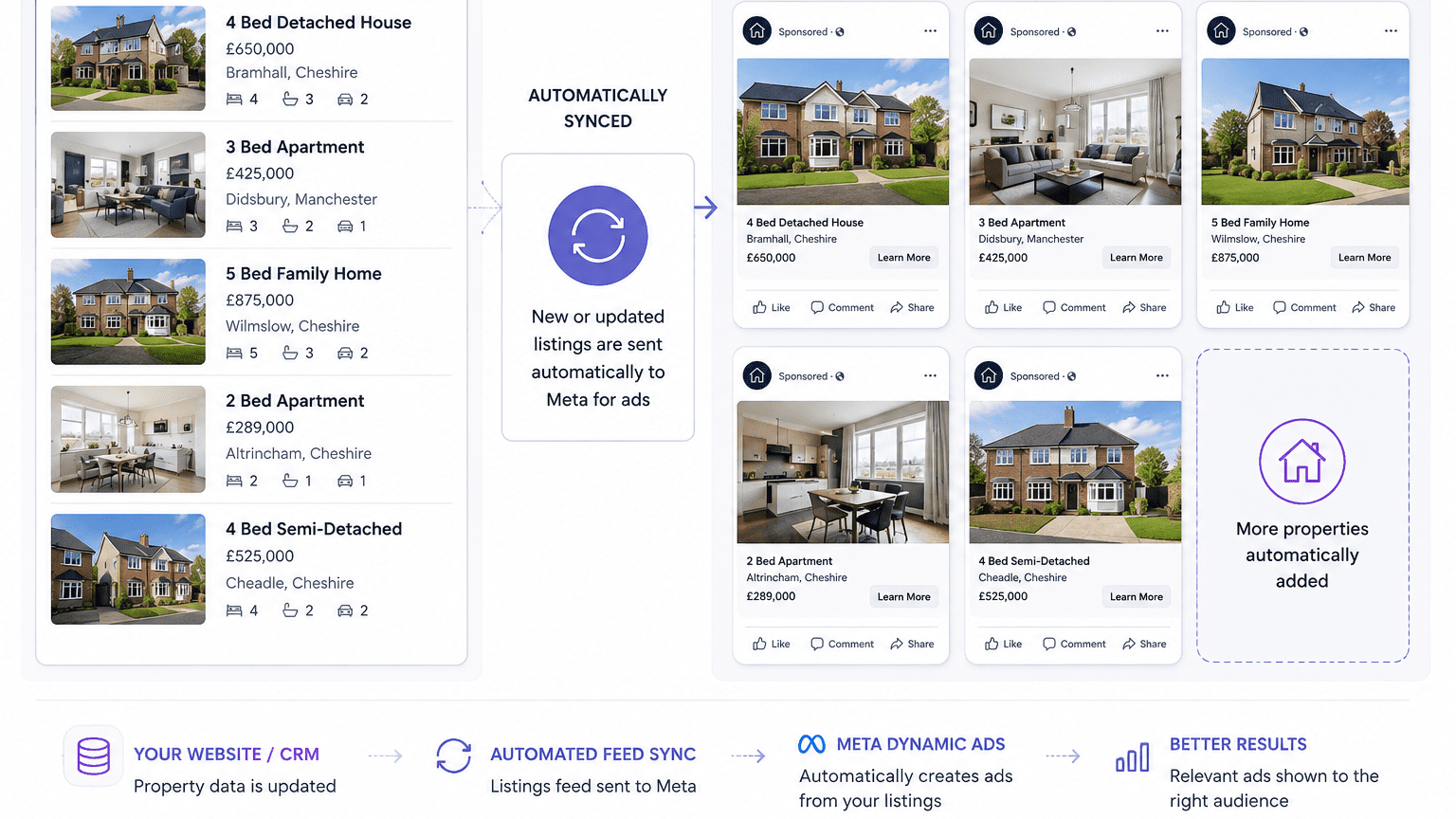
Every real estate agency already has one of the most valuable marketing assets it needs: property listings.
The problem is that listings are often treated as individual marketing tasks.
A new property goes live. Someone creates a social post. Someone builds a Meta ad. Someone updates a portal. Someone chooses images, writes copy, checks the price, updates the status, and repeats the process for the next listing.
That can work for a small number of properties. But as the number of listings grows, manual campaign setup becomes slow, inconsistent, and difficult to maintain.
Dynamic property ads solve a practical problem: they help turn property listing data into repeatable advertising campaigns.
Instead of rebuilding ads manually for every property, the agency can use a property feed to supply ad platforms with structured listing information. The campaign can then show relevant properties to buyers, renters, investors, or retargeting audiences based on the data available.
The value is not only more automation. The value is a better marketing system.
What dynamic property ads are
Dynamic ads use a data feed to generate ads automatically from a catalogue of items.
For real estate, those items are properties.
A property feed may include:
Property title.
Address or area.
Price.
Bedrooms.
Bathrooms.
Property type.
Listing status.
Images.
Description.
Property URL.
Open house details.
Availability.
Agent or branch.
Development name.
Rental or sale category.
This information can be used by platforms such as Meta to create ads that pull directly from the property catalogue.
The benefit is that ads can stay aligned with live listings. If a property is sold, let, withdrawn, or updated, the feed can help reduce the risk of promoting outdated information.
This is especially useful for agencies that manage multiple listings, new developments, rental portfolios, or frequent stock changes.
Why manual listing ads become a bottleneck
Manual property promotion creates several recurring issues.
The team spends time rebuilding similar ads.
Listings are promoted inconsistently.
Old property ads may continue running after status changes.
Campaigns depend on one person remembering every update.
Creative quality varies from listing to listing.
Tracking is often added late or missed.
Sales teams do not always know which ad generated which enquiry.
The issue is not that agents are doing anything wrong. The issue is that the process does not scale well.
If every new listing requires manual campaign setup, the marketing team spends too much time on production and not enough time on strategy, testing, and follow-up.
Dynamic ads help create a repeatable structure.
How a property feed changes the workflow
A property feed connects listing data to marketing platforms.
The feed may come from the agency website, property management system, CRM, XML feed, API, spreadsheet, or custom integration. The important point is that the data is structured and reliable enough to use in campaigns.
A typical workflow might look like this:
A property is added to the agency website.
The property data is included in a feed.
The feed updates the ad catalogue.
Dynamic ads use the catalogue to create property-specific ad units.
Users click through to the property page.
Tracking records the visit, enquiry, or viewing request.
CRM data records the lead source and property interest.
Retargeting audiences are built from property views and enquiries.
This turns property listings into a system rather than a set of manual tasks.
Practical real estate use cases
Buyer campaigns
Dynamic ads can promote active sales listings to potential buyers.
For example, a buyer who has viewed three-bedroom homes in a specific area may later see similar properties in a retargeting campaign.
This is more useful than showing the same generic agency ad to every visitor.
Rental campaigns
Rental listings often move quickly, which makes manual advertising difficult.
A dynamic setup can help promote available rental properties while reducing the chance of advertising properties that are no longer available.
The feed quality matters here. Status updates need to be accurate.
New developments
For developers or agencies marketing multiple units in a development, dynamic ads can help promote units by size, price, availability, or property type.
Instead of creating separate campaigns for every unit, the catalogue can support a more structured campaign approach.
Retargeting property viewers
A visitor who views a property but does not enquire is still valuable.
Dynamic retargeting can show that person the same property or similar listings later, depending on campaign setup and platform rules.
This keeps the agency visible without requiring manual follow-up ads for every listing.
Seller lead campaigns
Dynamic ads are often associated with buyer leads, but property data can also support seller marketing.
For example, an agency may use listing performance, local area pages, sold property examples, or valuation landing pages to build seller-focused campaigns.
A homeowner who views local market content or valuation pages may be added to a retargeting audience and later see ads encouraging a valuation request.
Why tracking matters
Dynamic ads are only useful if the agency can understand what happens after the click.
The campaign should connect to:
Property page visits.
Viewing requests.
Contact forms.
Valuation requests.
Phone clicks where possible.
Saved property actions where relevant.
CRM records.
Lead source and campaign data.
Without tracking, the agency may know that ads are running but not whether they are generating useful enquiries.
A basic but disciplined tracking setup can help answer:
Which listings attract attention?
Which ads generate enquiries?
Which property types produce better buyer leads?
Which campaigns produce seller valuation requests?
Which areas generate interest but low enquiry volume?
Which pages need better calls to action?
This is where the website, ads, CRM, and analytics need to work together.
Data quality is the foundation
Dynamic campaigns depend on the feed.
If property data is incomplete, outdated, or inconsistent, the ads suffer.
Common problems include missing images, inconsistent property types, old prices, sold properties still marked active, weak descriptions, broken URLs, and missing location fields.
The feed does not need to be perfect on day one. But it does need to be maintained.
A strong property-feed setup should include clear rules for required fields, listing status, image quality, URL structure, campaign eligibility, and update frequency.
CRM follow-up still matters
Dynamic ads can generate attention. They do not replace follow-up.
When someone enquires about a property, the CRM should capture:
Which property they enquired about.
Which campaign or channel produced the lead.
Whether they are a buyer, seller, landlord, tenant, or investor.
What action they requested.
Who owns the follow-up.
What next step is required.
For real estate teams, speed and context matter. A lead for a specific property should not arrive as a vague “website enquiry.”
Dynamic ads work best when the enquiry handoff is structured.
Practical dynamic property ads checklist
Property feed
- Are active listings available in a structured feed?
- Does the feed include title, price, location, images, status, and property URL?
- Are sold, let, withdrawn, or unavailable properties excluded?
- Are property types and locations named consistently?
- Is the feed updated often enough for your listing volume?
Website and property pages
- Do property pages have clear viewing or enquiry CTAs?
- Are property URLs stable and trackable?
- Are images good enough for ads?
- Are listing pages mobile-friendly?
- Are open house or viewing details clear where relevant?
Ad setup
- Is the property catalogue connected correctly?
- Are campaigns separated by sales, rentals, developments, or other useful groups?
- Are audiences defined clearly?
- Are property sets filtered properly?
- Are old or unavailable listings prevented from appearing?
Tracking
- Are property page views tracked?
- Are viewing requests and enquiry forms tracked?
- Are Meta and Google tracking configured correctly?
- Are UTM parameters used consistently?
- Does the CRM capture property interest and lead source?
Follow-up
- Are enquiries routed to the right agent or team?
- Does the CRM show the property the person enquired about?
- Are high-intent enquiries prioritised?
- Are missed-call or phone leads handled?
- Is lead quality reviewed regularly?
Turn your property listings into a repeatable ad system
Muser Agency helps real estate businesses set up dynamic property ads, property-feed automation, tracking, and CRM handoff so listings can be promoted with less manual campaign work.