


Plugin updates matter, but a useful website care plan should also cover forms, tracking, performance, content, security, and improvements.
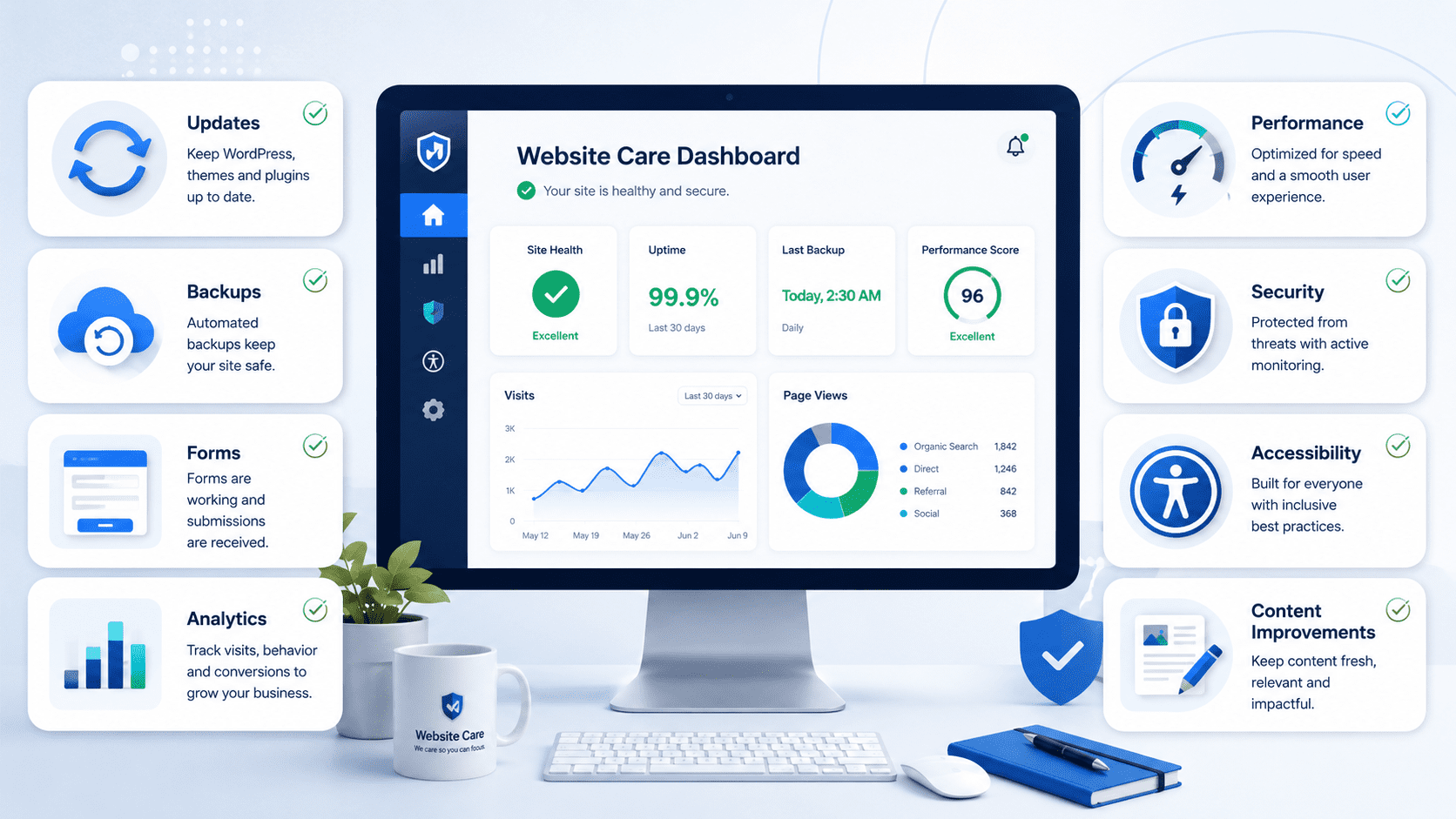
For many businesses, a website care plan means one thing: plugin updates.
That is understandable. WordPress plugins, themes, and core files need to be kept current. Updates can fix bugs, patch vulnerabilities, and maintain compatibility.
But if a care plan stops there, it is too narrow.
A business website is not just a set of files that need updating. It is a working part of the company’s sales, marketing, support, recruitment, and operations. It may handle enquiries, bookings, downloads, payments, CRM syncs, tracking scripts, campaign pages, consent tools, search visibility, and reporting.
Updating plugins is necessary. It is not the same as operating the website.
The difference between maintenance and operations
Maintenance keeps the website from becoming outdated or insecure.
Operations keeps the website useful to the business.
Those are related, but not identical.
A basic maintenance plan might update WordPress core, themes, and plugins. It may also include backups and uptime monitoring. That is a reasonable foundation.
A website operations plan goes further. It asks whether the site is still doing its job.
Are forms working?
Are leads reaching the right people?
Are analytics still accurate?
Are key pages loading quickly?
Are landing pages still aligned with current offers?
Are broken links or outdated team pages damaging trust?
Are tracking scripts still present after cookie banner, theme, or plugin changes?
A website can be fully updated and still underperform.
What basic care plans often miss
The most common gap is assuming that a technically updated website is a healthy website.
Here are areas that often fall outside basic plugin update plans.
Forms and lead capture
Forms are among the most important parts of many business websites. They are also easy to overlook after launch.
A contact form may still appear on the page but fail to send notifications. A quote request form may send emails but no longer sync to the CRM. A newsletter form may collect subscribers but miss required consent fields. A recruitment form may accept CV uploads but exceed file size limits.
If no one tests these flows regularly, failures can remain hidden.
CRM and API integrations
Many WordPress websites connect to HubSpot, Pipedrive, Salesforce, Mailchimp, ActiveCampaign, Zapier, Make, or custom APIs.
These integrations are not “set and forget.”
Fields change. Authentication expires. API versions move on. Sales processes evolve. A plugin update can alter behaviour. A CRM administrator may rename a field without realising the website depends on it.
An operations-minded care plan should include periodic integration checks, not just website software updates.
Analytics and tracking
Marketing teams often assume analytics are working because reports still contain numbers.
But numbers can be wrong.
A conversion event may stop firing. A thank-you page may change. Google Tag Manager may contain old tags from previous campaigns. Cookie consent settings may suppress tracking in ways no one has reviewed. A new landing page may be published without event tracking.
The business then makes decisions using incomplete data.
A useful care plan should include analytics and tracking QA, especially for forms, conversions, campaign pages, and key user journeys.
Performance and user experience
Plugin updates can improve performance, but they can also create new issues.
A new script may slow down the site. An image-heavy landing page may be added without compression. A page builder section may look fine on desktop but break on mobile. A cookie banner may cover a call-to-action button. A third-party chat tool may delay page loading.
Performance should be reviewed from the user’s perspective, not only through a technical score.
Content accuracy
Websites age quickly.
Service descriptions fall behind. Case studies no longer reflect the best work. Team members leave. Pricing language becomes outdated. Old campaign pages remain indexable. Blog posts mention offers that no longer exist.
A care plan that includes light content review and improvement helps prevent the website from becoming a polished archive of old decisions.
Security, backups, and recovery
Security still matters. Backups still matter. But they should be part of a broader operational view.
A backup is only useful if it can be restored. Security monitoring is only useful if someone knows how to respond. Plugin updates are only safe if there is a rollback plan when something breaks.
For business-critical websites, care should include both prevention and recovery thinking.
The business impact of neglected website operations
Website issues rarely stay technical.
A broken form becomes missed revenue.
Incorrect tracking becomes poor budget decisions.
Slow landing pages become weaker campaign performance.
Outdated content becomes sales friction.
Integration errors become manual admin.
Security incidents become operational disruption.
The cost is not only the repair work. It is the time spent discovering the issue, diagnosing it, explaining it internally, and rebuilding confidence in the website.
That is why recurring website care should be judged by business continuity, not just by the number of plugins updated.
Practical website operations checklist
Use this checklist to evaluate whether your current care plan is broad enough.
Technical foundation
- WordPress core, theme, and plugin updates are handled regularly.
- Updates are tested after completion.
- Backups are automated and stored offsite.
- Restore process has been tested.
- Security monitoring is active.
- Uptime monitoring is in place.
Lead capture and forms
- Important forms are tested monthly.
- Notifications go to current team members or shared inboxes.
- Form entries are stored where appropriate.
- Spam protection is working without blocking valid enquiries.
- File upload forms are tested for size and format issues.
Integrations
- CRM handoff is tested.
- API or webhook failures are reviewed.
- Required fields are mapped correctly.
- Automations triggered by website submissions are checked.
- Ownership of integration issues is clear.
Tracking and reporting
- Conversion events are tested.
- Google Tag Manager or tracking scripts are reviewed after site changes.
- Campaign landing pages have correct tracking.
- Consent settings are understood.
- Reports match the business questions being asked.
Content and usability
- Key service pages are reviewed for outdated information.
- Broken links are checked.
- Mobile layouts are reviewed.
- Calls to action are current.
- Important pages are reviewed for clarity and friction.
Improvement process
- Issues are logged and prioritised.
- Small improvements are made regularly.
- Monthly reporting explains what changed and why.
- Website work is connected to business goals, not only technical tasks.
What a better care plan looks like
A stronger website care plan combines maintenance, monitoring, and improvement.
It should keep the website secure and updated. It should also protect the systems that turn visitors into enquiries, customers, bookings, subscribers, or applicants.
For a WordPress website, that may mean:
Monthly updates and backups.
Form and CRM testing.
Analytics and conversion tracking QA.
Performance review.
Landing page checks.
Small content and UX improvements.
Clear reporting and recommendations.
This does not mean every month needs a major project. In many cases, the value comes from regular attention. Small fixes prevent bigger issues. Minor improvements compound. The website stays aligned with how the business actually operates.
Keep your WordPress website working after launch
Muser Agency’s WordPress care and improvement plan is built for businesses that need more than routine plugin updates. We help maintain, test, monitor, and improve the website systems that support leads, campaigns, reporting, and day-to-day operations.